
CHRONICLE | The Full Story of the 2023 UMich GEO Strike [Part 2]
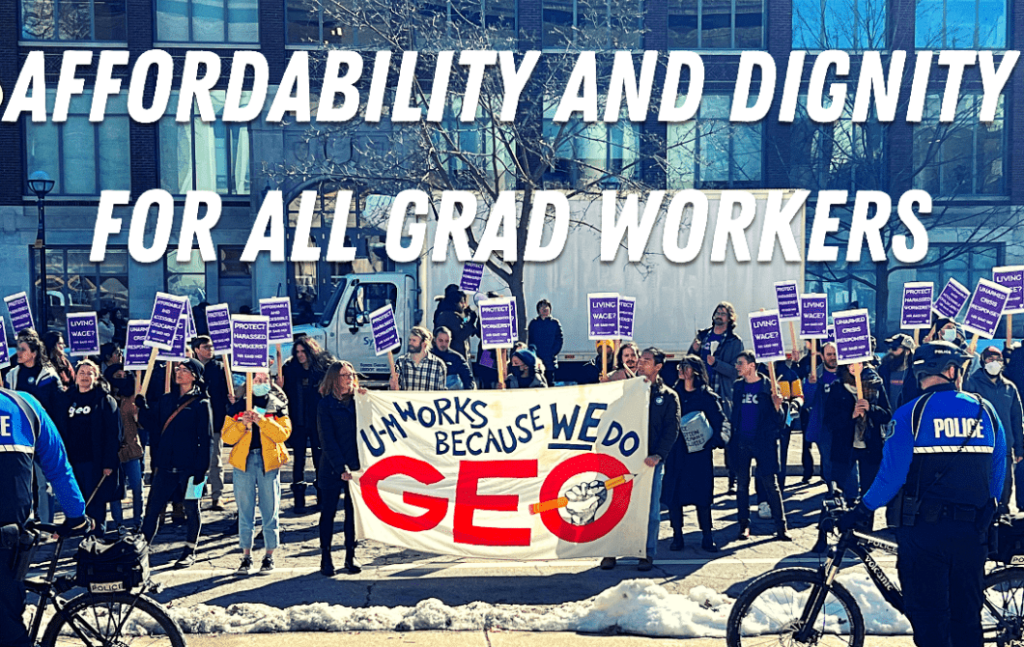
Photo by UMich GEO https://www.geo3550.org/why-we-strike/
The Road to Striking
We saw that we might not reach an agreement, so the union began conducting a survey to gauge everyone’s readiness to strike. On one hand, this survey was an organizational tool to tell people what striking is and what the risks are if you strike; we also told everyone that if we are going to strike, only by having more people strike together can we reduce the individual risks we face and increase our chances of winning the strike. On the other hand, we asked whether everyone was willing to commit to a strike. We collected nearly 1,600 surveys within two weeks, of which 96 percent promised to strike. This was basically a structural test, where we saw the extent of everyone’s strike readiness, which we used to decide whether we wanted to initiate a strike authorization vote. We saw 96 percent of 1,600 people very actively committed to a strike, so we decided around the end of March to hold a general body meeting to hold a strike authorization vote. A strike authorization vote means that union members authorize the union to strike, but this does not mean that the strike will begin immediately. It’s essentially a threat to the school telling them that we now have the power to strike.
Question: was the strike pledge survey collected through a web-based form?
Actually, we were mostly offline. Because our primary goal was to organize, not just to gather people’s opinions. The organizing process itself is most important, not just the result. That is, we used in-person conversations to tell people what the strike is about, and that we can only do something about what we’re facing if we go on strike. So most of us actually did it through one-on-one conversations. Lots of organizers were responsible for collecting pledge cards from multiple people in person, on which they wrote whether they wanted to strike or not. For those that were off campus, we also had an online version of the pledge cards, but our survey was primarily conducted offline. There were definitely a lot of people involved and many people were needed to do it together.
Our survey passed with a 96 percent support rate, and then we decided in late March to hold a strike authorization vote. Three days before our strike authorization vote, the school which had up until then maintained that our minimum stipend proposal was not achievable suddenly released a 12-month financial support plan for Ph.Ds. This funding package claimed to provide full summer funding to Ph.Ds at the Ann Arbor campus. Let me tell you about Ph.D. funding at Ann Arbor: as Ph.D. students, we’re generally required to teach in the fall and spring semesters, with each semester lasting four months, and for these two semesters we get a teaching assistantship. But in addition to these two semesters, we have four months of summer session. The four months over the summer actually depend on the department. If the department has funds to support Ph.D.s, they might pay for the four month summer stipend. Last year’s salary was $12,000 per semester. So it’s two semesters in the fall and winter, and if you’re teaching, your income is $24,000, and then if you get a full summer stipend, it’s another $12,000, and your annual income is about $36,000.
But some departments, like humanities, social sciences, and arts, are not able to provide full summer stipends. Some departments basically don’t offer money for the summer, so you have to apply for grants or stipends on your own. In those cases, a lot of Ph.D.s have no income for the whole four months of the summer. In other words, at the university level, the minimum annual stipend in Ann Arbor is $24,000 for those who only get income for the fall and spring semesters. In negotiations, we sought to represent this group of people making the minimum university stipend. Our proposal at the time meant that we were going to raise the minimum annual stipend of the entire school for Ph.D., to a living wage in Ann Arbor, from $24,000 to about $39,000 for the entire year. The school then insisted in the previous negotiations that the proposal was impossible. The term they used was “infeasible”, i.e. totally impossible. But we’d been looking into the financial costs, and meeting this requirement requires $32 million, yet the school scoreboards cost more than $40 million. The school believed that the money is better spent on the scoreboards than on you teaching assistants.
The school kept saying no in previous negotiation sessions, and now suddenly offered a plan three days before our strike authorization vote to provide full summer funding to all Ph.Ds. In a sense, if the plan were to be implemented, then Ph.D. minimum annual income would be $36,000, which would largely fulfill our earlier request for $39,000. And what the school was saying was that the program could start this summer. That is to say, in the four previous months of negotiations, the school’s insistence that our proposal was completely impossible to achieve had become largely enforceable three days before the strike authorization vote and could be implemented immediately. That’s what everyone was talking about. But it was clear to everyone who was aware that this is in fact a strategy to prevent striking. Indeed, one of the problems with the school’s financial proposal is that the school made it clear that it had nothing to do with union negotiations and that it was impossible to write into our contract. That’s why during the discussions among the general body and in departments, there was agreement that the summer funding proposal was certainly good, but if it couldn’t be written into the contract, the implementation of the proposal would provide no guarantees to graduate workers. Moreover, at that time, the school had made little concessions on all other proposals, so we recognized that a strike was the only way to force the school to make concessions.
Therefore, even though the school had offered 12-month funding at the time, we still ran the strike authorization vote. The strike authorization vote passed with 95 percent, giving the union the authority to strike. However, it did not mean an immediate strike, and we provided a deadline to the school where we would strike if the school didn’t concede. This was the situation at the time — even though the school offered a seemingly good financial solution, we eventually chose a strike, which was a more important milestone. And it later proved that, although the financial support proposal was presented as a long-term funding proposal, it was subsequently very confusing during the summer: some students were promised that they would receive the money, but eventually their department said it would not be available this year. In particular, there are more senior students in humanities and social sciences (like seventh and eighth years) who were clearly not guaranteed to receive the money in this proposal. At first, the school promised it would be possible, but in the end, when it was implemented, the grads still hadn’t received the money. The school said the funding came from the Graduate School, but when they later communicated with the department, the department leadership told them that we can give you money this year, but starting next year, you’ll have to figure out where the money will come from yourself. We can now see that this was definitely not a plan the school made with long-term intentions, but probably something hastily put together in a few weeks just to deal with the strike.
Question: the 12 month funding proposal is equivalent to only one year’s wages, and there was no commitment for the second year?
The school told graduate workers that the 12-month funding package would be implemented long-term, that they would provide this every year and they wouldn’t withdraw the support. But in fact when grads went to speak to department chairs, they found it meant that we might have money this year, but how do we get that money next year? This was not what the school said to graduate workers at the time, and it ended up being completely different. It was only later that we saw the school’s proposal was not a long-term solution. They did implement the plan in the summer, but it was very confusing and some did not get the money promised from the school.
Internal and External Pressure During the Strike
Our strike was finally launched on March 29th, because the school didn’t actually make any concessions after our strike threat. I can say a few specifics about the strike. What I personally felt was pressure from our faculty. Because our department was a STEM department, and our chair was super opposed to the strike, he was very anti-union. He sent an email at the beginning of the strike telling us that if you were on strike, it would affect your advisor’s assessment. Most of the faculty in our department have a very strong voice in the field, and they used insinuations to tell you what power they have so it doesn’t constitute a clear threat. But people started to think about their career prospects after that email. Additionally, the chair put pressure on the teaching faculty to ensure the teaching tasks were completed. Many instructors are actually AP (assistant professors) who haven’t yet received tenure. Their access to tenure depends a lot on the opinions of the department leadership. So the admin put pressure on these people, saying that you have to make sure the teaching mission is carried out. So many assistant professors were actually under a lot of pressure and some were willing to grade homework for hundreds of students themselves. At the time some of them took out this pressure towards the teaching assistants on strike. Of course, there were also some very sympathetic people in the department, but because of the department atmosphere at the time, they didn’t dare to speak up.
When we first conducted our strike survey, our unit was 60 percent willing to strike at first, but then the actual strike rate was less than 50 percent because of the threat by faculty. There was a department organizer who was very emotional at the time, and they told everyone directly at the department meeting that the strike would definitely fail in this department. It was very difficult to start a strike. Even with a 96 percent pass rate, when it does start, you can feel the tension and fear among the workers, and the internal conflicts are really big. The general body meeting that launched the strike was also very tense. There were a number of rank and file graduate workers who attacked union leaders at general body meeting. They said, “well, we’re authorized to strike, but why did you start the strike so early? Why didn’t you wait two weeks and see if the school would give you a good offer?” In fact, you can see that it’s fear and nervousness, but they expressed this emotion as criticism of the decision. But since we had launched the strike at the end of March, and the end of that term was at the end of April, it was actually pretty late if we wanted it to be effective. We also believed that, rationally, if we waited longer, it wouldn’t benefit the negotiations. There were also rumours inside the school that there were many people in our school who thought that the union was controlled by a small group of radicals who had planned a long-haul strike for more than six weeks long ago, when in fact everyone who authorized the strike voted for more than six weeks.
But these were just rumors. Because we actually voted every week during the strike, we never said upfront it would be a long-haul strike. It’s only that union leaders told everyone that in order to force the school to compromise, it would probably be a longer strike, but they didn’t plan for a long strike from the get go. So an important part of our work at the time was to talk to teaching assistants and people in the department about the issue, to determine everyone’s attitude and thoughts. But the more important part was to appease the emotions that you can’t resolve in a large audience like at a general body meeting. You can only deal with the emotional problems by talking to each other one on one within the department. My feeling at the time was that, first of all, you clearly understand that behind these rumors and disagreements, everyone is actually experiencing panic and fear about the strike due to external pressure. It might not be rational, but it definitely needs to be addressed. If it’s not dealt with, it becomes a deep internal conflict. I think one of the most important jobs of union leadership at the time was to distinguish between emotional outbursts and rational decision making. They have to be able to make the right decisions, but on the other hand they must be able to take care of everyone’s emotions and fears that they express and address them in conversations. That was one of the things I felt strongly about. When there are significant internal conflicts, this handling is still quite troublesome and some of the situations during the strike at that time were actually not very smooth. Even though we had a 96% strike authorization, you can see that there were actually many internal conflicts.
The “Injunction”
Moving on after the beginning of the strike, the school began to take some direct legal measures. Let me share the context: Michigan state law doesn’t actually allow public sector employees to strike. Because the University of Michigan is a public school, we are actually public sector employees, which means that Michigan state law does not allow us to strike. Additionally, we had a no-strike clause in our contract, which means during the contract period we agreed not to strike. That is to say, since we launched a strike at the time, it was a double offense. It not only violated our own contract but also state law, so the school could bring an injunction request to stop our strike. If this injunction was passed in court, we would face a very high fine, and the fine would increase every day we did not return to work, which means that if we continued to strike the fine would accumulate every day and increase. Then I can share the background to the injunction. The injunction has a very notorious history in the US. It was first implemented in the Great Depression before Roosevelt’s New Deal to suppress large-scale collective labor actions. It’s a legal tool used to break strikes.
In fact, the injunction became mostly obsolete during the Roosevelt New Deal. In the private sector it was largely removed nationwide, but in the public sector, it depends on state laws. Although injunctions are generally not used, there are still a number of places that use them, and Michigan is a state in which injunctions can be imposed on public sector employees, as we knew before the strike. When we were rallying everyone’s support, we made it clear that if we really called a strike, it wasn’t that our actions were unreasonable, but that the legal system itself was unfair from the workers perspective. So when we went on strike, it wasn’t that our actions were unreasonable or unjust; on the contrary, we were using the strike to resist the unjust legal system itself. This was part of our organizational work at the time. We explained to everyone the potential risks involved; against this backdrop—naturally—everyone ultimately decided to proceed with the strike. When we first decided to strike, we were prepared to face the injunction, and we did not even think that it would be rejected in court. But the result was that two weeks after the injunction had been requested by the school, when they had a two-week hearing in court, the court’s ultimate decision was that they would not issue the injunction.
The judge at the time stated that there was no evidence that the strike by the students had caused irreparable harm to the school, so he saw no reason to grant the injunction. So it was actually a very unexpected and very significant success for us. We were ready to talk about all the legal outcomes, and we’re thinking, what would we do if this thing really came out? I think that the pressure that we all had was, to a large extent, the result of what we thought would be a failure. But the result is to say that we decided to launch a strike when we knew it was an illegal strike; and that this attempt to use a strike to resist the unjust legal system itself was finally successful in court. The court also ruled that our actions should not be deemed unlawful. Therefore, this actually represents a very significant development in the progress of our strike.
Q&A 1
Question: what would you have done if the injunction was passed?
As for our approach, we decided at the time that we should proceed based on the specific requirements of that injunction because we didn’t know what it would be. But we thought it was possible to try. Then, depending on the outcome, we would decide what to do next. Yeah, we didn’t have a specific plan at the time, so that’s where the panic came from.
In the end, the injunction surprisingly wasn’t issued, and was a very important milestone for what we finally won.
Question: How did you manage people’s emotions?
We mainly planned to picket outside the courtroom. We wanted everyone to be able to express our anger to the school, not internally. Because the school pursued the injunction, it was basically equivalent to an unwillingness to respond to our legitimate economic claims in favor of bringing us to court. For many students, this was actually very difficult to accept; they found it emotionally unpalatable—specifically, the realization of just how outrageous the school truly is. So we encouraged them to vent this sentiment at the picket, encouraged people to attend and listen to our hearings and support our legal team outside the courtroom. To help calm everyone down, we held a ton of discussions.
Question: Were students who struck threatened by advisors that they wouldn’t be allowed to graduate?
There was no direct threat to graduation by advisors, they simply implied that “your participation in the strike would affect their assessment of you”. It’s a very vague thing to say and they don’t explicitly threaten your graduation because it’s illegal. If you want to threaten your students’ graduation, it must have something to do with their academic progress. But that’s besides the point. According to school policy, advisors aren’t allowed to threaten you by saying things like “You won’t graduate”, etc.
Question: What are the consequences of directly and explicitly threatening to write a negative recommendation for a student in the future?
(The faculty) might suggest writing a negative recommendation. That is, if it’s a direct student of that advisor, they might have this concern. But if a lot of people go on strike, can they target you? Of course there are people (who might actually be written about negatively?). This is actually very vague, and there is indeed this risk, and we can’t say that everyone joining the strike can completely avoid it. But we can tell people that you can consider your personal situation and weigh the risks yourself. Indeed, some people simply didn’t participate in the strike.
Question: If a student is directly threatened, will an advisor be sanctioned for a violation of policy?
In fact, advisors cannot threaten their students directly because of the strike, because your student status, your ability to graduate and so on, has nothing to do with actions related to your employment status. There’s a very clear, lengthy procedure in the school rules for not graduating students, and you have to go through it, because you can fire a student for reasons related to academic progress. So advisors do not usually do so because they have no right to threaten this. But there are also advisors who threaten students with false information, especially by using international student visas, in cases where students may not know the specific law, but this is actually not legal. These acts of intimidation can be prosecuted, but legal proceedings are also lengthy and may not generally be pursued. As far as I know, teachers do not generally threaten students directly (with regard to graduation), and they only suggest, at a somewhat vague level, that participation in a strike affects their assessment of you.
Question: What is the relationship between the school union and the national union?
For sure there is some legal aid, technical support, etc. provided to us by the national union. The school also communicates with us through the national union. Although many of our legal services are provided by our national, in many cases the strategy of the national union is not exactly in line with ours, which they sometimes take advantage of to make us drop legal proceedings with the school. The dynamic generally exists such that the influence of the national union on our decision-making is not very significant, but it is true that the school will take advantage of this to allow the national union to interfere with our decisions.
Withholding April Pay
In April, the school lost its injunction request in court. For us, this was a very significant victory. But for the university, they only played one card and there are many ways in which they can break a strike.
The court decided not to issue the injunction in mid-April. By the end of April, the school instituted work attestations, and demanded that all students fill it out. One reason for this is that if the school wants to withhold your pay, they have to have evidence that you didn’t work during that time. But we were on strike with a lot of people, and there was no way to know if advisors didn’t report who was working and who wasn’t. So legally, it’s very difficult to determine whether a student is actually working. Then, because the entire teaching assistant system was campus-wide and highly decentralized, the university devised a new solution: using work attestations.
Everyone voted to agree not to fill out that form. So there was no evidence to the school that you were working. The school sent it out as much as three times per week, saying that “you can’t get paid unless you fill out this form”. We decided to all take collective action against the attestation form and told everyone, including those not on strike, not to fill it out. In the end, most people didn’t fill out this form.
In other words, if you don’t fill out the form, the school assumes you’re not working. In this case, the school decided to withhold pay from all non-attesting workers. In reality, under these circumstances, this constitutes an unlawful wage deduction. However, in an effort to break the strike, the school did indeed proceed to deduct the wages regardless. In short, while the action was technically illegal, they went ahead and did it anyway.
Campus Police Detain Protesting Students
In addition to this, in April, a number of students confronted our President in a hotel and asked him why he had been illegally withholding their salary. They wanted to talk to the president about this situation; the president came out and went into his car and wanted to leave; many students stopped in front of the car, and the president called the school police to a place a few blocks away from the school district. There were confrontations after which a number of students were arrested, although they were released shortly thereafter. It was during the height of the conflict that incidents like these occurred.
Even after the school decided to withhold our entire April salary—and despite the school’s attempts to thwart the strike through legal action and wage deductions—they refused to make any concessions regarding our contracts. Under these circumstances, we decided to continue the strike.