
CHRONICLE | The Full Story of the 2023 UMich GEO Strike [Part 1]
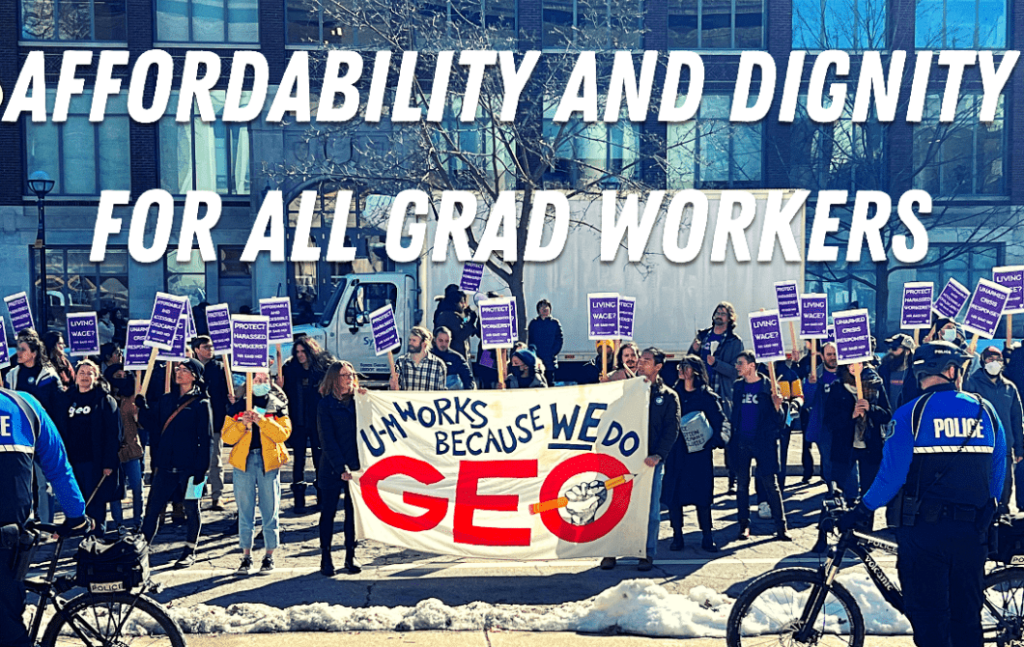
Photo by UMich GEO https://www.geo3550.org/why-we-strike/
Original article: https://mp.weixin.qq.com/s/pkejCM3Rz0W8EE6-6qHfHg
Editor’s Note:
Throughout this nearly five-month strike, graduate workers at the University of Michigan were not intimidated by an unjust anti-labor legal system, nor did they back down in the face of the university’s escalating intimidation and repression. Instead, by standing together in solidarity, they secured a proposal that is unprecedented in many ways: 12-month funding for all Ph.D. students at the Ann Arbor campus, a 60% increase in the minimum annual income for Ph.D. students in the first year to meet Ann Arbor’s minimum living wage standard of $39,000; the establishment of a transition fund to provide one semester of financial support for workers in unhealthy employment environments; the creation of an emergency fund for international students; a statement from the president supporting community-led, unarmed crisis response programs as an alternative to police; expanded health insurance coverage for transgender individuals; and improved campus facilities and assistance for people with disabilities, among other measures. This article provides a detailed account of the nearly nine-month process from the start of negotiations to the end of the strike, documenting how the University of Michigan’s graduate student workers achieved victory step by step through an exceptionally difficult struggle.
Speaker | Da Tian (Ph.D. candidate, University of Michigan)
Compiled by | Lie Fu, Da Wulong
Q&A | Zhang Taibo
My name is Da Tian, and I am currently a doctoral student at the University of Michigan, Ann Arbor. During the past year of negotiations and the strike, I was primarily responsible for organizing efforts within the department, and I am now one of the leaders of the union’s organizing committee. I’ve been involved in union organizing within our department since the fall of 2021. My work in the first year focused on educating department members about what the union does, why they should join, and encouraging them to register as union members. In the second year—the year of negotiations—I primarily communicated weekly updates on the progress of negotiations and, toward the end of the process, gathered feedback from everyone regarding the strike. So, I’ll spend the next part of my talk outlining the negotiation process. We actually had a full nine months of negotiations. I’d like to walk you through our winding journey and explain how we ultimately secured that final contract.
Basic Background
Let me start by giving you some background on the situation of workers at U.S. universities. In addition to being students, doctoral candidates at U.S. universities typically provide teaching or research services to the university as teaching assistants or research assistants. Essentially, we work for the university, using this as our primary source of income to fund our Ph.D. studies. A union is an organization formed by us, the university workers, to negotiate with the university collectively, fighting for our wages, benefits, and the protection of our labor rights. The contract negotiated by our union actually benefits all graduate student employees. If you are a teaching assistant, you are covered by this contract. In theory, as beneficiaries of the contract, each of us should become a union member, pay dues to support the union’s operations, and participate in the union’s activities. However, because of a bill passed in Michigan in 2012, not all employees covered by the union contract automatically become union members. Since then, we’ve had to actively reach out to employees—specifically our teaching assistants—to organize them, talk to them about what the union is, and encourage them to join. In other words, that law effectively allows some people to benefit from the contract terms without paying union dues—it is, in fact, an anti-union law.
Since that labor law was passed, membership rates and revenue sources for most unions have dropped significantly. The law was specifically designed to weaken unions and their bargaining power, and it has indeed achieved that result. Of course, on one hand, the law has forced us union organizers to reach out to people and explain what a union is; on the other hand, it has also given us even more motivation to engage in outreach and organize more people—otherwise, we might not have any members at all. That’s why I mentioned earlier that my work in the first year was primarily focused on explaining to people within the department what unions do and encouraging them to join. When we’re doing organizing work, we usually also explain that our current union operates quite differently from previous organizational models.
Many years ago, people viewed the union as service providers, and paying dues was essentially paying for a service—specifically, the services of organizing strikes and conducting negotiations. Workers didn’t organize themselves; instead, they paid for certain services and let the union handle things on their behalf. However, very recently—in fact, starting with these negotiations—we’ve adopted a different approach to the union. This is called the “organizing model.” We believe the union isn’t a third-party organization providing services to everyone, but rather it is the workers themselves. We don’t think it’s enough just to pay dues; instead, when we encounter problems in the workplace, we should bring them up and work together within the union to find solutions. The union acts as a collective for everyone, and we consider how to use the power of collective action to resolve the issues we face in the workplace. In other words, it is only in the very recent years that we have come to believe that a union should not be merely a third-party service provider, but rather a space where people can come together to solve the problems we all face. It is essential that everyone organizes themselves; this is the model we follow. Therefore, in our organizational work, we emphasize empowering workers—empowering them to believe that when problems arise, we can find solutions ourselves, with the union providing support so that we can resolve these issues through collective strength.
This provides some general background on U.S. universities and the situation of workers at those institutions. I can now briefly outline the context of our negotiations and the history of our union. The University of Michigan union was founded in 1974 and is one of the earliest graduate student unions established in the United States. The University of Michigan union represents all graduate teaching assistants across the university and negotiates a ccontract with the university every three years. The three-year negotiation cycle is illustrated in the figure below.
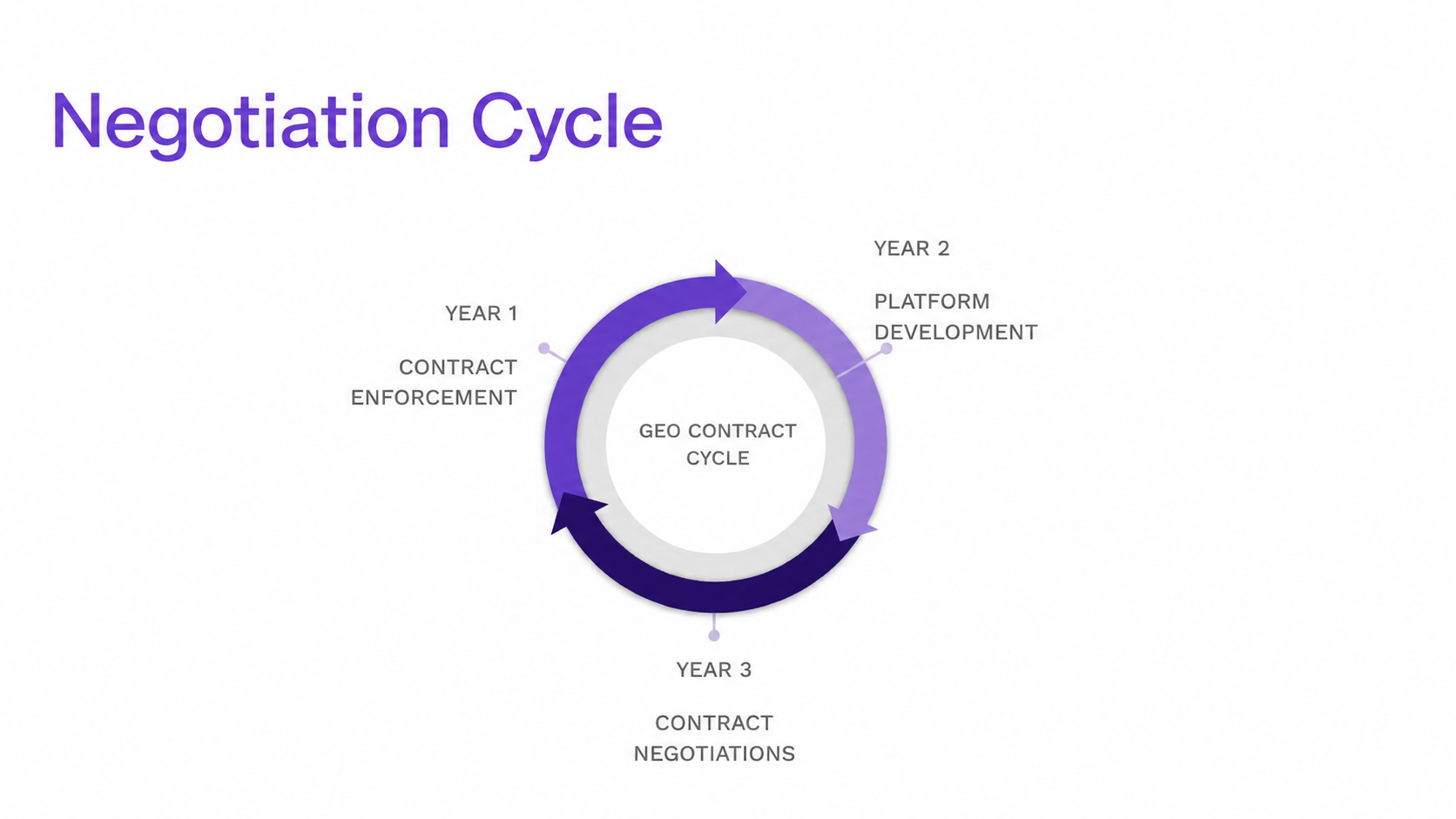
Photo by: UMich GEO Orientation Slides.
Once the previous bargaining cycle concludes, we spend the first year primarily educating members about the contract’s contents and ensuring that its provisions are implemented. In the second year of the bargaining cycle, we conduct a very extensive, long-term survey of graduate workers across the university to identify issues in various aspects of their lives that need to be addressed. During this process, we also recruit individuals willing to join the negotiations for the following year. If someone is particularly interested in certain issues or feels they are critical to address, we encourage them to get involved in organizing efforts, help draft relevant demands for the next year, and prepare for the upcoming negotiation cycle. In the third year, we formally negotiate with the university. This is our three-year negotiation cycle. The past year—2022 to 2023—was precisely our negotiation year, corresponding to the third year in this diagram. Therefore, our negotiations, including the strike, all took place during the third year of this cycle. That is the general background.
Next, I’d like to outline some of our key demands leading up to the negotiations. These demands were actually finalized during the second year of the contract cycle, with separate negotiation teams responsible for different issues drafting them. First and foremost—and likely the issue of greatest concern to everyone—is the economic demand: that the minimum annual income for graduate workers in Ann Arbor should meet the city’s minimum living wage, which was approximately $39,000 at the time. There were also issues related to anti-discrimination and sexual harassment, including providing a one-semester transition fund for workers in unhealthy working relationships, so that they could use that time to change advisors or extricate themselves from such unhealthy situations. Then there are health insurance and childcare benefits, which primarily involve expanding health insurance coverage, lowering out-of-pocket costs, and increasing childcare subsidies and their eligibility criteria. Additionally, there are issues concerning international students, with the main demand being the establishment of an emergency fund for them. The background for this stems from an incident during the pandemic where an Asian student had a family member who was seriously ill, but airfare was extremely expensive at the time, and he was unable to return home because he could not afford the ticket.
In addition, international students face certain visa-related challenges. This means that, compared to domestic students, international students face greater risks. Therefore, some of us raised the demand to establish a separate emergency fund for international students to cover these additional expenses, as well as to reimburse them for extra visa fees. There are also some more locally focused political issues, including police abolition —a demand closely tied to U.S. universities and Black students. The main demand in this area was to redirect funding from the campus police to a community-led, unarmed crisis response program—essentially investing in an alternative to the campus police. Additionally, there was a call for easier access to healthcare services for the transgender community. We had a dedicated negotiation team handling this issue, which also included providing better campus facilities and support for students with disabilities.
These were our primary demands prior to negotiations, and they had actually been finalized and voted on at a general assembly before negotiations began. From the outset of negotiations, we established a clear principle: to treat all demands as a unified whole, meaning there were no priorities among these issues. Furthermore, we conducted extensive research on each issue, demonstrating why these demands were achievable for the university and presenting ample evidence to show why these were our minimum requirements. We believed the university didn’t need to engage in bargaining; these were our minimum demands, and the university was fully capable of meeting them. Therefore, during negotiations, we told the university that we did not view our proposals as setting an inflated offer from which they could gradually negotiate and chip away at our demands. These were our thoughts and principles at the very beginning of the negotiations.
Next, I’d like to give you a brief overview of the timeline of events following the start of formal negotiations. Our negotiations lasted a very long time, beginning in earnest last November and continuing until March 29 of this year, when we went on strike. The strike lasted five months, continuing through the end of summer break—roughly until the end of August—and ending just before the start of the fall semester. Today, I’d like to walk you through this process.
The Fight For Open Bargaining
First, I’d like to talk about how we managed to secure open bargaining. Our negotiations began last November.
In previous negotiation cycles, our approach was for the union to select a negotiation team of about ten people. These individuals would then meet with the university’s HR representatives in a small room for six or seven hours one day a week to discuss the contract. This process would continue for several months. Most graduate student workers who weren’t directly involved in the negotiations found it difficult to know exactly what was happening during the process. Major decisions regarding the negotiations were generally made solely by the negotiating team at the table. On one hand, the psychological pressure on the dozen or so members of the negotiating team was immense, especially since the negotiation cycle could last for months. However, the university’s HR representatives were highly paid professionals specifically hired by the university to handle these matters; they didn’t face this same issue. But members of the negotiating team are all graduate students who dedicate their spare time to this work. Consequently, as the negotiation period drags on, it becomes increasingly difficult for everyone to maintain the energy required to keep up. By the later stages, the negotiating team finds itself in a highly unequal position relative to the university administration. Furthermore, due to a lack of transparency, mistrust can develop between the negotiating team and the rank-and-file graduate student workers. No one knows exactly what is happening during the negotiations. If decisions are made directly by those at the negotiating table, it is impossible to know whether those decisions align with what everyone wants or whether the majority of workers agree. Such situations have occurred in the past. Because we were aware of these issues beforehand, we spent the first two months of this negotiation process insisting that the university make the negotiations public.
Our negotiations began in mid-November, and from the very start, we insisted to the university that these negotiations must be conducted openly. By “open bargaining,” we mean that we demanded all graduate students be allowed to observe the proceedings. We believed the negotiations should take place in a larger room so that any graduate worker who wished to attend could do so as an observer. If they couldn’t be present in person, they should also be provided with the option to observe the negotiations via video conference. In other words, we wanted to ensure that all graduate student workers had the right to know exactly what was happening at the negotiating table. At first, the university strongly opposed this request. During those initial two months, HR flatly refused to attend any public negotiations; their stance was very firm. This impasse lasted for a long time, and eventually, the university even brought in a third-party mediator. Typically, a third-party mediator is only brought in during the later stages of negotiations, when progress has stalled. However, in our case, the university took this step within the first two months, bringing in an outside party to handle the situation.
In these two months, in fact, we barely talked about any other specific issues. Two months passed, and there was practically no progress in negotiations, so the pressure on our union was immense at that time. At first, the university was extremely stubborn and they refused to attend anything, and there was no sense that they would concede to open bargaining. But we still thought that it was crucial and necessary, especially in such circumstances, to continue to pursue open bargaining. In the end, the school finally compromised and agreed to open bargaining about mid-January, two months later. The school also told us at the very beginning that you were coming to negotiate with us, and if you were to change rooms, you must pay us for the space. In other words, when we graduate students negotiated with the university, the university actually demanded that we pay venue fees. The university made a lot of demands like this, but after two months, they finally agreed to hold public negotiations. I believe this was the first major breakthrough in the entire negotiation and strike process.
Open bargaining is also one of the biggest differences between our current campaign and previous ones. Our subsequent experience has also proved that calling for open bargaining is in fact the correct decision, because open bargaining ensured that everyone could see what management was saying and how they behaved at the bargaining table. This, in fact, helped us to organize a lot – the administration’s behavior at the bargaining table was a good mobilization tool as it showed how unreasonable the university was. I’ll talk more about this later. So open bargaining was our first milestone at the time. I consider it the first – and quite significant – breakthrough.
The Administration’s Arrogant Negotiating Stance
We were two months behind in the negotiations at that time, since we basically had a period when we did not talk about any contract clauses. Based on past negotiating experiences, in a normal negotiation cycle, we usually reach a tentative agreement on March 1st. But this year, because we hadn’t talked about any contract proposals, the specific offer the school put forward in February was highly significant. Furthermore, we believe that whatever the school proposes in February likely represents the offer they seriously think should be given to us.
So what kind of offer did they propose? Because most graduate workers were concerned with financial issues and what wage increases would be for the next three years, the university offered a 2 percent annual wage increase for the next three years in February. For context, the highest inflation rate in the US was over 9 percent last year, which means that if the school only provides us with this 2 percent increase, the increase in the next three years might not keep pace with the high inflation rate. Which means that the school’s offer actually reduced salaries for graduate workers. We had our tentative agreement date on March 1st, but when the school presented the February offer, it was so insulting that many of us who had not been following the progress of the negotiations before felt angry. Everyone thought it was absolutely outrageous.
For background, the University of Michigan is a public school, and all its financial budgets and expenditures are in fact public. Before the negotiations began, we hired an economics professor to investigate the school’s financial situation. We knew from this report that our proposed minimum annual stipend was fully achievable for the university. For example, in 2022, the school approved a $41 million budget for the purchase of new football scoreboards. One important source of income for U.S. universities is sports, football, and then money from selling tickets. But we calculated that our minimum stipend proposal would only cost the university $32 million. In other words, even in a very generous financial situation, the school only offered raises of 2 percent, 2 percent, and 2 percent, even though our proposal was completely affordable.
The US university model is in some ways very similar to that of a business. The highest level of decision-making happens at the Board of Regents. These people have significant influence and can decide the appointment and removal of the President, and they are usually the most influential in the negotiations. And who makes up the Board of Regents? Here’s one example: there are eight members, one of which is Ann Arbor’s largest realtor and a huge financial donor of the Michigan Republican Party. This man was one of the main financial backers of Trump’s campaign in Michigan when he ran in 2016. These Regents are very similar to a company’s Board of Directors, and others like the President and the Deans are very much like the managers of a company. One of the President’s main jobs is to raise more money for the school. For example, the University of Michigan’s endowment last year was approximately $18 billion. This is a huge amount of money, higher than the GDP of many small countries, but that money is primarily for financial investment. The administrators are, to a large extent, acting like fund managers for the school’s investments for profit. Thus, students are more like consumers, paying for an educational service and a degree, then getting a job on the market with the diploma as a product of the school. The service that schools provide to students is actually very similar to this kind of relationship.
So we can see that, in fact, during open bargaining, the school didn’t care whether our claims were legitimate. In the negotiations, we provided a rationale for our proposal, why it was achievable, and we did a lot of research on each of our claims. We sent these to the university, but during the entire cycle of negotiations in February, they wouldn’t even tell everyone why they refused. They just said that it’s not possible, it’s not possible. Essentially like that. So this open bargaining is not, as you might think, that both sides are putting forward their offers. It’s not even a bargaining process, but us alone telling the school why we need these proposals, why they are reasonable, and then the school was so arrogant that they wouldn’t even give a good explanation when they refused. This was the context of the school’s offer in February and the negotiations that took place at that time. March 1st was the deadline for our initial agreement in previous years, but at this point in the year we realized it wouldn’t be met, because the school’s counter offer was so far off from our proposals. I’ve only mentioned economic issues, but the school essentially completely rejected many other proposals. They only conceded on very minor issues. For example, on issues like providing the union with information boards, they might show a little flexibility, but on other issues, they were essentially unwilling to make any concessions.