
CHRONICLE | The Full Story of the 2023 UMich GEO Strike [Part 3]
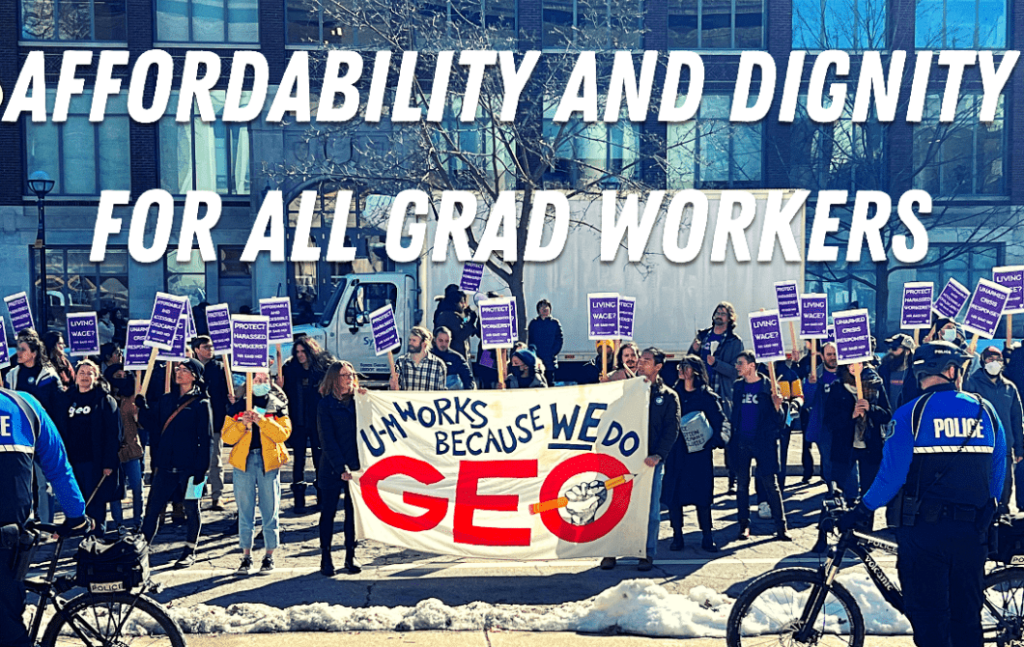
Photo by UMich GEO https://www.geo3550.org/why-we-strike/
Fabrication of Final Grades
This process continued right up until the end of the semester. In fact, for students at universities, their final grades are their biggest bargaining chip. The most important concern of the school is whether the final results are submitted on time.
At the end of the semester, the school found that they had used legal means, that they had withheld wages, but that they had not prevented our strike. The strike continued and they finally started to send e-mails threatening communities other than grad assistants. For example, they sent emails pressuring lecturers to submit their grades. Because lecturers are contract workers, the school implied their contract for next year may not be renewed if the course grades weren’t input on time this year. They’ll suggest something like that. Schools find it difficult to undermine collective action within unions through such actions when unions — for example, our unions — are organized at a higher level. But there are other groups on campus, whose unions may not be as organized, and they can easily threaten them. So when the school ran into difficulties blocking our strike directly, they turned to pressure on others. Then they threatened the lecturers to submit the grades, and I suppose some of the higher-ups put pressure on them.
Then the lecturers’ union in our school did little, and said to the lecturers that if the lecturers wanted our help (TAs) with the grades, there was no way for them to provide support and help. The lecturers’ union did not want to organize a collective action to tell the lecturers that we could work together to help the teaching assistants withhold grades; they weren’t organized enough. So I felt that, although some of the lecturers at the time were very sympathetic to the strike, if they were to face the pressure from the school, very few people would have chosen to help with this. So a lot of pressure was transferred to these lecturers at the time, and some might really need to grade hundreds of assignments.
But the TA strike rate was high at the time, so even though the school pressured lecturers to hire a few scabs (some graduate students to take over the work) or something, they couldn’t finish all the work. What did the school do in the end? They sent direct emails to the department leadership, clearly directing them to give all students As if they couldn’t find enough lecturers or hire enough scabs to grade all the assignments, but everyone must submit the grades on time. This is a crazy thing, because Michigan is probably the first university in the US to give department leadership such clear direction that they can be a university that gives students straight As because of a TA strike. The school was clearly doing something like that, and we were shocked, it was just crazy.
Even at the end of the semester, the school didn’t compromise on any of our proposals and negotiations were still ongoing. The last wage increase given by the school was 5% – 3% – 2%, which totalled 11% over 3 years, or similar to last year’s inflation rate, and they still didn’t say that they would include the 12 month funding in our contract. One of our very important proposals then was that the 12 month funding plan had to be included in our contract, and they hadn’t moved at all on this. Other major proposals were largely not conceded to. They used all these means to force us to accept their offer. But we didn’t compromise until the summer.
During the summer vacation, we mainly focused on handling some legal litigation, because over the summer there’s not a lot of TAs. Although our strike was technically ongoing, it wasn’t possible to carry out much of the strike itself during the summer semester. On one hand, we reported the school’s behavior to the institution that accreditates teaching qualifications. We provided a lot of evidence and hoped that they would open an investigation. On the other hand, we brought a number of legal complaints against the school for illegally withholding wages in April. Summer session was mostly about these things. Then, even while facing all these legal proceedings, the school made little progress throughout the summer.
The accreditation board initially said the school would be investigated and considered it a serious matter. But by the end of July, they suddenly stated that there had been no apparent misconduct by the school in the matter and decided not to investigate. The school had obviously done this with clear evidence, but you can see that behind the school is US bureaucracy. Even for such a violation, after a few months they considered it a minor matter that could be let go. So this was also something we felt at the time.
August: The “Explosive” Contract That Didn’t Explode
And then something happened at the end of August. At that time, when the new semester was about to begin, we felt that if the school didn’t concede, we would have to consider the possibility of continuing to strike in the new semester. Then we organized some discussions about continuing the strike in August.
It was not until mid-August that the university, through our national union, conveyed to us an oral contract. They said that the school intends to reach an agreement with us before the start of the new semester, that they will basically concede to our main demands, including wage increases keeping pace with inflation. They made a verbal promise at this point that it may be possible, that they also believed that the 12 month funding plan could be included in our contract, and that there are other things. They didn’t come directly to us, they didn’t give us a written contract, they told our national union that there would be such a contract, and the message was to ask us to provide a response within 48 hours. If we did not accept the contract at that time, it would be cancelled and then we would go back to the same negotiation process before the strike.
It was only 48 hours, it was very vague and there was no clear written proposal, just telling us through our national union that it would be a very good proposal that basically met all your demands. So we discussed it in a general body meeting. Although the school said it would be cancelled after 48 hours, we concluded that since the strike had already taken place, any concessions now made by the school must be based on the leverage that resulted from our actual strike, not that the school could take it back if it wanted to. This wasn’t the school doing us a favor, it was a concession that we forced through our strike.
So we just felt that when the school said “if there is no response within 48 hours, it will be withdrawn,” it must be just a threat and a negotiation tactic. So in the discussion we decided that we couldn’t respond in such a short time, that we had to have another week of discussion before deciding should we wait for further offers, or should we just accept this offer?
So the result of our discussion at that time was that we didn’t consider the contract, which the school said would explode and be canceled, out of respect for collective decision making. We just told the school that we can’t respond in this timeframe, and we have to discuss it again and then inform you of our decisions. Then in the following week, we had a lot of discussions at the department and school level. During that week, various meetings were held to explain to everyone what this contract would be like, and what the advantages and disadvantages of the contract were, and then everyone engaged in a lot of discussion. Finally, after that week of discussion, we decided to send the school a counterproposal because we didn’t think that the contract was entirely acceptable to us and wanted to negotiate remaining issues with the school.
Then, a week later, this supposedly “explosive contract” – it turned out that they only cancelled some very, very marginal proposals. They said they would give us a bonus, and the bonus was cancelled after that week, but the rest of the contract they didn’t actually take back.
At the negotiating table, we insisted on giving them our counter offer, and the school was still negotiating with us, and then we had a few more negotiations. In the end, it was before the end of August that we finalized the tentative agreement which essentially included all our previous proposals. First, in the next three years, wage increases will increase to 8 percent, 6 percent and 6 percent. The 12 month funding package including summer support, which the school had always said “for various technical reasons could not be included in the contract”, was finally included in the contract. They then contribute $20,000 per year to the emergency fund for international grads. They also pledged to set up a transition fund, starting this year, to provide a semester of funding for graduate workers in unhealthy advisor situations.
Furthermore, the president who had summoned campus police to arrest students during the strike ultimately agreed, at the conclusion of our strike, to issue a public statement supporting the proposal to abolish the police. I think this is also a very significant win, as they said at the time in previous bargaining sessions that the call to abolish the police was a larger issue of school security, that it had nothing to do with our employment relationship or employment negotiations. But finally it turns out that what you can actually talk about doesn’t depend on the school’s claims, and it doesn’t depend on the technical details. It’s essentially who has more power and how much leverage you can get to force these concessions. So long as your bargaining power is strong enough, none of the reasons cited by the school are valid; there is absolutely a way to make this happen.
There were considerable wins for trans folks, and many of their health coverage demands were won. Then there are disability rights. It is these aspects that were basically finally won in this contract, and they were basically achieved. Of course, there are still some lingering issues, such as the inequality between our three campuses, where the treatment between the three campuses has not been fully balanced; then there are schools such as the music college, where they still do not receive summer funding, which is standard for all PHDs in the school, but their degree is DMA. Although their work is similar to what we do, they do not benefit from this summer funding package.
Secondly, regarding our April wages: prior to the strike, we had informed everyone that our goal was to recover these funds from the university before the strike began. However—because the university ultimately resorted to using fabricated grades, unilaterally awarding all students straight A’s, and faced no oversight from higher authorities—they saw no need to backpay teaching assistants to complete the outstanding work. This situation differs significantly from that of other institutions—such as Columbia University, for instance—and consequently, the university had grounds to withhold those payments. Thus, this issue effectively remains an unresolved legacy from the contract we ultimately secured.
However, at the end of August, when the union voted, our contract was finally adopted with a 97 percent yes vote. So it wasn’t until the end of August that we finalized the contract; by then, we had pretty much completed the entire process. While we acknowledged that there were problems in this contract, we said that we could still discuss those omissions and that, while there might not be a way to achieve our demands by continuing the strike, we hoped that it could be incorporated into future negotiations through a longer-term organizational strategy. This is the summary of the whole situation.
Q&A 2
Question: You mentioned earlier the recent shift of unions from the service model to organizing model, can you elaborate on how this process of change has taken place within the union? How was it raised and communicated? How did members consult and were there any conflicts?
This is, in fact, a change in strategy that I think is primarily due to a change in leadership. I think that during the process of organizing the union a few years ago, there was a lot of dissatisfaction within the union regarding the actions of the leadership at the time, because the previous leadership had been less willing to confront the school when faced with it. Like we had a strike in 2020, it was during the pandemic, and the school announced that it would reopen and allow everyone to return to class. Thus in fall 2020, the union struck mainly against the policy of reopening the school, particularly the idea of whether or not everyone should attend classes online, in order to ensure their safety.
I was not specifically involved in this at the time, but what I know through the current leadership is, of course, that there was a lot of dissatisfaction with the union approach, including their organizational model and their mode of work, that it was easy for former union leaders to compromise with the school, and that it might not be possible to achieve what we really wanted, so some of the problems that were revealed then. In the subsequent change of leadership process, some of those who were dissatisfied with the status quo organized themselves together, and then they took the initiative of taking over union leadership, and then they started to use their work philosophy to lead the union’s next campaign, moving from a service model to an organizational model. So the shift was, in fact, mainly because those who were less satisfied with the status quo organized themselves, and then they took on the role of the leader, and they contributed to this.
As far as I know, there have actually been some conflicts in the process of moving from a service model to an organizational model, some of them being between past and present leadership. But in the end, rank and file voted to elect our current leadership, and then we made this shift.
Question: What is the structure of the grad union in Michigan, and how long is the term of office? And how did this change of leadership take place? Or are there some appointments?
We change each year, and the structure of our union is like this: as a formal body we have an Organizing Committee. This Organizing Committee is responsible for internal organization, which involves holding department-wide meetings. Every two weeks, we provide an update on recent developments and discuss what actions need to be taken within the department.
We then have a Political Action Committee, which is primarily responsible for external work, which is to coordinate with other political groups on the ground, and then we will organize some political actions together. For example, the recent campaign of solidarity with Palestine, many of which was actually done by our Political Action Committee. So there is internal and external organizing. These are the two central sectors of our work.
Then we have small groups (caucuses) which focus on different topics. We have groups that focus on police abolition, international student issues, the rights of masters’ students, trans students, etc. They focus on these issues on a long-term basis, and they set up their own working groups before the strike to develop their respective demands.
In addition to the permanent departments, we have a number of meetings, which are divided into meetings of the general body and of departmental organizers. All members of the unit can attend, and if you are involved in the organization, you can come. The biweekly meeting of the departmental organizers is our main channel of communication with the departments. And then our union actually encourages the creation of caucuses, which means that as a worker, if you have a subject you’re personally concerned about, you can organize yourself, and then you can form a group, and then you can focus on it and push it forward.
So it’s like that. On the whole, I think it’s a relatively flat organization.
For elections, we have candidates every year. We usually change at the end of April, and every year at the end of April we’ll do a full general body vote. But in reality, our previous elections were essentially uncontested elections—not competitive ones—so there weren’t actually that many candidates.
One of our ideologies is that democracy is not in itself the form of a vote. One of our feelings at the time was that there should not be a lot of candidates, like electoral politics in the United States, and then some speeches or something, which I think is not the most effective form of democracy. The most effective form is having a mechanism to participate in the process. I think if you ask some of the rank and file workers if they want to join, it would be easy for them to get involved first in the work of the Organizing Committee, and then you get involved in the organization, and then you get in touch with the leadership. I think that the leadership of many unions has emerged as part of their involvement in the work of these organizations. Then, in the election, it is usually these people who take on the responsibilities for the next term.
So I don’t think that this election process is all about going through someone you don’t know at all, and then the campaign, and then a lot of ads, and then some speeches, and then a vote. In my view, the current model—where a rank-and-file worker progresses from participating in grassroots departmental organizations to joining the core leadership of the university-wide labor union, and ultimately rises to a leadership position—strikes me as a process that genuinely embodies the principles of participatory democracy. I feel that this voting method differs somewhat from the type of campaign style that is relatively common in the United States; however, it is indeed a system where everyone gets to vote.
Question: I would like to ask: is the process to first gather the demands drafted by the various issue-specific working groups, submit them to the university, and then proceed to face-to-face negotiations with the administration? And what specific preparations are required prior to these negotiations—such as developing negotiation or communication strategies?
This is the approach we took regarding the proposals from different interest groups. We have groups that focus on different topics, they write their own demands, and then we wrap them up as a whole, and then we hand them over to the school directly at the start of the negotiations with the school. So our proposal, which is the equivalent of a whole-of-the-school congress, was put together, and we presented the whole package to the school, not individually.
The national union will provide us with some training to prepare us for negotiations. The union does provide some strategies on how to negotiate, but in reality, it is primarily the graduate student workers themselves who are doing the actual negotiating. We’re not professional negotiators, but those who were in charge of negotiations in previous contract cycles have a lot of experience. We also went to Labor Notes at the time, a labor conference in the US, where they talked about a lot of strategies for negotiation and so on, and they had some trainings.
Question: Could you briefly describe the political activities about Palestine? For example, how to organize participation and what are the pros and cons of union participation?
With regard to Palestine, what our union is doing now is probably these things. Last month, we made a public statement in support of Palestine. But there was a lot of resistance to this, and there were a lot of union members at the school, maybe about 100 people in the end who said they were leaving because we made a statement. So it’s like organizing a political campaign in Palestine. It’s hard in the US to implement it at the department level. Just like we did during the strike, our organization actually went through every department one to one. But I think the Palestinian campaign is actually still far from the same degree [as the strike].
The main thing is that you are in coalition with other pro-Palestinian groups, including organizations like undergraduates that support Palestine, and we have some activities with them. The main focus is on schools, for example, where we protest, hold sit-ins, and occupy school buildings, but he is not pushed to such a level of organization as the department.
Because it may be difficult to get as much support in the department as it is on a labor issue, and at the same time to take into account the fact that Zionists in American universities are very powerful. And then when you’re going to do this organizing, there’s a very high risk of being threatened, so the resistance is still very high. So in reality the Palestine issue is not something that’s easy to organize around. I think it is a rather big step that we have been able to make a public statement this year, but we might still be far from being able to have some impact on the situation through our actions. For example, we considered if some research labs at the university were providing technical support to some of the companies involved in the Israeli-Palestinian war, could have had some direct impact by intervening in their actions. These are some ideas, but they have not yet been concretely implemented. Yes, I think that organizing for Palestine is a longer-term undertaking, but at this stage, I feel that though the situation has moved a bit further, in general it is not yet a very concrete level yet.
Question: There are two small questions, the first of which is that you spoke earlier about the need for open bargaining and that you thought this was a very important step in the work last year. At other universities in the U.S.—for example, many universities went on strike last year—have they made similar efforts? Is this a more consensual strategy for U.S. higher education unions, or is the Michigan union unique?
Not all of the negotiations, as I know, were open, as was the case at Rutgers University. But we know that open bargaining has been a recent trend and that there are indeed many universities that have pursued the open bargaining strategy. When we were at Labor Notes the year before the negotiations, there were a lot of people advocating for open negotiations. And in recent years, as far as the United States-wide unions are concerned, I think this is a strategy that many unions have begun to use. When we heard about it from other unions, we decided to use this open bargaining strategy.
As far as U.S. higher education unions are concerned, there are many higher education institutions that use this strategy, including California schools, but not all. There are also a lot of higher education institutions that don’t, and they’re still doing the same thing as they used to do behind closed doors.
Question: Could we trouble Da Tian to briefly introduce the bonus redistribution thing that our union is doing this fall?
Well, because our April salary is a lingering issue. The school was refusing to pay us back this part of the salary, and instead they made an agreement with us in the contract that they would give all fall assistants a $1,000 bonus, and they would probably pay it in full, probably $2 million, which is the same amount as the withheld wages in April.
So the school refused to return the money in the form of backpay, and the reason they gave the bonus was that it was a reward for not going on strike. Then, during the fall at that time, one of our very important tasks was to acknowledge that our judgment of the situation back then was wrong. At that time, we thought we could recover this wage through the strike agreement, but in the end, we did not get it back. So, as a compensation strategy, we collected everyone’s fall bonuses and then redistributed a portion of the bonuses to those who lost wages.
It’s one of our main jobs this semester. We hope that based on this collective sense of solidarity, everyone can know that your wages, including those of all the contracts you received during this term, comes from the huge sacrifices of those who lost their wages last semester, and the school may also use similar methods to break future strikes. So I think it is to say that in order for future students to see the sustainability of our strike and this kind of strategy, we hope everyone can show their solidarity and donate their bonuses. Actually, this bonus is just an extra benefit for them, and then redistribute this bonus to workers who did not receive a bonus, and these workers made great sacrifices. So this is a very important action for us here. Right now, this matter is still ongoing, and we are still in the process of collecting money.
Question: What kind of organization work does the union do at the department level when there is no strike?
When there aren’t any strikes at the department level, generally speaking the year after the strike ends is dominated by contract enforcement. There are many ways the school can circumvent the actual implementation of these things after the contract is written. So we’ll tell you that if you want this contract to work, you’ll have to continuously organize and decide to make it a reality. One big problem after negotiations, for example, is that contracts are circumvented by the school and they don’t work out. So what’s really important is not that this thing you’re talking about ends up in the contract, but also that you have to organize to make sure it’s done. If they don’t do it, you’ll always have to organize yourself to force the school to do it. So this is what we did in the first year after the strike. Our main work is educational, that is, to tell everyone what contents are in our contract.
Then in the following year, we need to conduct a survey, a comprehensive survey, to see what else people need or what their demands are, and then we prepare for the negotiations for the next year. So, in our three-year negotiation cycle, each year actually has different tasks. The organizational work is more intensive in the year of the strike negotiations, but in fact, every year there is still a lot of work that needs to be done.
Question: When negotiations didn’t go well in the early stages, did the negotiators face significant pressure? And how did they overcome that pressure to move the negotiations forward? (In the face of setbacks, how did they stay committed to their goals?)
How do negotiators deal with pressure?
I think that’s an excellent question. I believe open bargianing is crucial. If you’re just dealing with a dozen or so people, and no matter how much you plead your case and explain your reasoning, they just say “no”—that situation is incredibly oppressive. Anyone who’s ever participated in negotiations probably knows how stifling that environment can be, and it’s very difficult to sustain that for many months. That’s why I believe open bargaining is particularly helpful in this regard. When negotiations aren’t going well, the negotiators don’t feel like they’re alone at the table; instead, they know that all of us graduate student workers are standing together to face the feedback the university is giving us—including all the pressure they’re putting on us, their lack of response, and every other form of pressure. They can feel in that room that there are indeed people there to support them.
We constantly organized people to go to the room and listen to the negotiation, and then I felt like the people at the negotiation table didn’t feel so alone. Then if the people at the bargaining table don’t know what to do, you can pause for 15 minutes and discuss among the room what to do. So I think open bargaining was very meaningful.
Question: Was there third-party mediation during the negotiations?
In the beginning of open bargaining the school had already brought in a third-party mediator. Then, when we didn’t make progress, the school also threatened some legal measures, such as fact finding. They thought we were negotiating in bad faith and it wasn’t our intention to reach an outcome, but in fact the school hadn’t actually responded to us. In the subsequent months, they tried to initiate some legal procedures to say that we weren’t bargaining in good faith. Then there was also finding a mediator, using many, many methods, so indeed there was third-party involvement.